
Dental cleaning is one of the most commonly recommended veterinary procedures — and one of the most frequently postponed by owners due to uncertainty about cost. Understanding what influences the price of a dog dental cleaning in Edmonton, what the procedure actually involves, and why it matters for your dog’s long-term health helps you make an informed decision rather than an indefinitely deferred one.
If your dog is overdue for a dental check or you would like to discuss what a dental cleaning involves for your specific dog, contact Walker Lake Veterinary Centre at (587) 786-6771 and our team will walk you through what to expect.
Professional dental cleaning is not simply a cosmetic procedure — it is a health intervention. Dental disease is the most common medical condition in dogs and its consequences extend well beyond the mouth to the kidneys, liver, and heart. The cost of regular dental care is significantly less than the cost of managing the systemic consequences of untreated dental disease.
Why the Cost of a Dog Dental Cleaning Varies
No two dental cleanings are the same. At Walker Lake Veterinary Centre, we cannot give you a precise total cost before the procedure — the full extent of dental disease only becomes apparent once your dog is anaesthetised and dental radiographs have been taken. What we always do is provide a clear estimate range before the procedure and call you during it if we identify significant additional work beyond what was anticipated — nothing proceeds without your consent.
What makes each procedure different — and what influences the final cost — is explained below.
Factors That Affect the Cost
Pre-Anaesthetic Bloodwork
Before any anaesthetic procedure, we recommend bloodwork to assess your dog’s organ function and identify any conditions that affect how we manage anaesthesia. For younger dogs with no health concerns, an abbreviated panel may be appropriate. For dogs over 7 years, we recommend a comprehensive panel. This is an important safety step we take seriously at Walker Lake Veterinary Centre and it adds to the overall cost of the procedure.
Anaesthesia
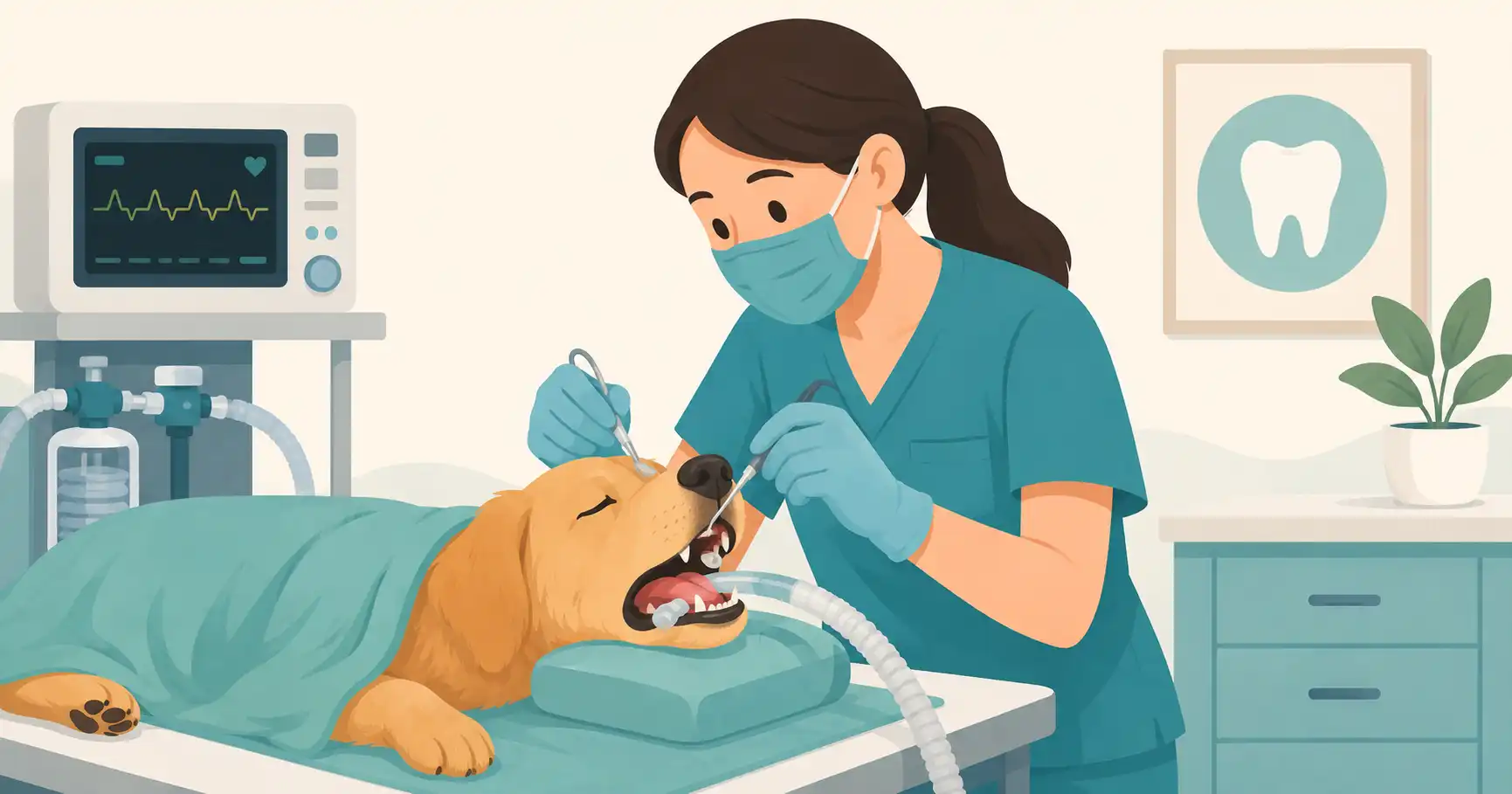
A professional dental cleaning requires general anaesthesia — this is non-negotiable and it is something we are not willing to compromise on. Anaesthesia-free dental cleaning is not a safe or effective alternative. Without anaesthesia, we cannot safely access below the gumline, cannot take dental radiographs, and cannot perform a thorough examination of every tooth surface. At Walker Lake Veterinary Centre, your dog is monitored continuously throughout anaesthesia — heart rate, oxygen saturation, blood pressure, temperature, and end-tidal CO2 — by a dedicated veterinary nurse.
Dental Radiography
Full mouth dental radiographs are a standard part of every dental procedure we perform — not an optional add-on. Up to 60% of significant dental disease occurs below the gumline and is completely invisible without X-rays. We take radiographs of every tooth, not just the ones that look problematic visually, because disease that cannot be seen cannot be treated. This adds to the cost but it is what separates a thorough dental procedure from a superficial one.
Scaling and Polishing
This is the core of the procedure — removing tartar above and below the gumline, root planing of affected areas, and polishing tooth surfaces to slow future plaque accumulation. The time our team spends on this step depends directly on the amount of tartar present and the distribution of periodontal disease. A dog with mild accumulation requires a shorter procedure than one with significant disease across multiple teeth.
Extractions
When our dental assessment identifies teeth that cannot be saved — through advanced periodontal disease, tooth resorption, fracture, or severe mobility — extraction is the right course of action. We never extract a tooth without first taking radiographs and discussing the finding with you.
The cost of extractions depends on the number of teeth involved, their size, and the complexity of the extraction. Simple extractions of small teeth require less time. Surgical extraction of large teeth — canine teeth and carnassial teeth — requires removing surrounding bone, sectioning multi-rooted teeth, and placing sutures to close the site. We provide post-operative pain relief as standard after any extractions.
Your Dog’s Size
Larger dogs require higher doses of anaesthetic drugs and typically take longer to process through recovery. This means the anaesthetic component is slightly higher for large and giant breeds compared to small breeds with equivalent dental disease.
The Severity of Your Dog’s Dental Disease
This is ultimately the biggest variable. A young dog with mild tartar and healthy supporting structures requires a straightforward, relatively short procedure. An older dog with advanced periodontal disease affecting multiple teeth, significant bone loss, and several extractions required is a far more involved procedure. We assess this as thoroughly as possible at the pre-procedure examination but the full picture only emerges once your dog is under anaesthesia and radiographs are in hand.
What We Include in Every Dental Cleaning at Walker Lake Veterinary Centre
When you bring your dog in for a dental cleaning, here is what our team provides as standard:
- Pre-anaesthetic assessment including review of bloodwork
- Intravenous catheter placement and IV fluid support throughout the procedure
- General anaesthesia with continuous monitoring by a dedicated veterinary nurse
- Full mouth dental radiographs of every tooth
- Systematic oral examination under anaesthesia — probing every tooth for pocket depth, mobility, and surface integrity
- Supragingival scaling — removal of all visible tartar from tooth surfaces
- Subgingival scaling — removal of calculus and bacteria from below the gumline
- Root planing — smoothing root surfaces to discourage bacterial reattachment
- Polishing — smoothing enamel surfaces to slow future plaque accumulation
- Irrigation of periodontal pockets
- Extractions where indicated — always discussed with you before proceeding
- Post-procedure pain medication
- Full anaesthetic recovery monitoring before your dog goes home
- Written discharge report detailing every finding and every tooth treated
- Home care guidance and recommendations for ongoing dental health
Is Anaesthesia-Free Dental Cleaning a Cheaper Alternative?
We are asked this question regularly and the answer is no — anaesthesia-free dental cleaning is not a cheaper alternative. It is a different thing entirely, and not something we offer or recommend.
Here is why:
- It only removes visible tartar from tooth surfaces — it does not address subgingival bacteria where periodontal disease actually develops and progresses
- It cannot be performed safely or thoroughly in a conscious dog — the instruments required for proper scaling and root planing cannot be used in an awake animal without causing injury
- It is not possible to take dental radiographs without anaesthesia — so the 60% of dental disease that occurs below the gumline goes completely undetected and untreated
- It causes significant stress to the dog
- It creates the appearance of clean teeth while leaving the underlying disease untreated
- Dental boards and veterinary associations in Canada and the United States consistently advise against this practice
A dog that has had an anaesthesia-free cleaning may look like their teeth have been treated — but without addressing what is happening below the gumline, the disease continues to progress. It is not something we are willing to offer at Walker Lake Veterinary Centre because it would not genuinely serve your dog’s health.
How Often Does Your Dog Need a Professional Dental Cleaning?
This depends on the individual dog and is something we discuss at every annual wellness examination. As a general guide:
- Most dogs benefit from a professional cleaning every 12 to 18 months
- Small breeds — Toy Poodles, Chihuahuas, Yorkshire Terriers, Shih Tzus — accumulate tartar more quickly and often need cleaning more frequently
- Dogs with excellent home dental care — particularly those whose owners brush their teeth daily — may be able to extend the interval between cleanings
- Dogs with a history of significant dental disease benefit from more frequent monitoring
At Walker Lake Veterinary Centre, we assess your dog’s dental health as part of every annual wellness examination and advise you on when we recommend the next cleaning based on what we find.
How to Reduce the Long-Term Cost of Your Dog’s Dental Care
Start Before Disease Progresses
The earlier we see your dog for a dental cleaning, the simpler the procedure. A dog with mild tartar and healthy gums requires a much shorter, less involved procedure than one whose dental disease has been allowed to reach the stage of multiple extractions. Starting regular cleanings before disease becomes significant is the most cost-effective approach over your dog’s lifetime.
Daily Home Dental Care
Daily tooth brushing is the single most effective thing you can do at home to slow plaque and tartar accumulation between professional cleanings. It extends the time before the next cleaning is needed and reduces the severity of what we find when we do clean — both of which reduce costs over time.
If your dog will not tolerate brushing, VOHC-approved dental chews, dental diets, and water additives are meaningful alternatives. We can advise you on what is most appropriate for your dog.
Pet Insurance
Some pet insurance policies include dental coverage as part of a wellness package or as treatment coverage for dental disease. We recommend reviewing your policy carefully and asking specifically about dental coverage before you need it.
Ask Us About Payment Options
If cost is a concern, please talk to us about it directly. We would rather have that conversation and find a way to prioritise your dog’s most urgent dental needs than have you leave without a plan. Addressing the most painful and infected teeth first — even if a complete cleaning is completed at a follow-up appointment — is always better than postponing everything indefinitely.
What Happens If Dental Cleaning Is Postponed?
Dental disease is progressive. Every month without treatment allows:
- Continued bacterial accumulation below the gumline
- Progressive bone loss around tooth roots
- Additional teeth reaching the point of requiring extraction
- Ongoing bacteraemia — bacteria entering the bloodstream from infected gum tissue — placing cumulative burden on the kidneys, liver, and heart
- Increasing pain for your dog — who continues to eat despite significant oral discomfort because the drive to eat overrides the pain signal
A cleaning performed when disease is mild involves less time, fewer extractions, and less cost than one performed once disease has progressed significantly. Postponing does not save money in the long run — it typically increases the eventual cost while allowing your dog to experience unnecessary ongoing pain.
Book a dental assessment at Walker Lake Veterinary Centre and our team will examine your dog’s teeth, advise on what treatment is needed, and walk you through exactly what to expect. Call (587) 786-6771 or book online. Located at 5109 22 Avenue SW, Southwest Edmonton.
Book an Appointment at Walker Lake Veterinary Centre
Walker Lake Veterinary Centre provides professional dental cleaning, dental radiography, extractions, and home care guidance for dogs and cats across Walker Lake, Summerside, Ellerslie, Heritage Valley, and Southwest Edmonton.
Call us at (587) 786-6771 or book online. We are located at 5109 22 Avenue SW, Edmonton.
Clinic hours:
- Monday, Tuesday & Thursday: 9:00 AM – 7:00 PM
- Wednesday & Friday: 9:00 AM – 6:00 PM
- Saturday: 9:00 AM – 3:00 PM
- Sunday: Closed
Frequently Asked Questions
Why does dog dental cleaning cost what it does?
The cost reflects the genuine complexity of what we do — general anaesthesia with continuous monitoring, full mouth dental radiographs, thorough scaling above and below the gumline, and appropriate post-procedure care. It is the equivalent of a minor surgical procedure in terms of resources, staff time, and equipment involved. We do not cut corners on monitoring or radiography, and that is reflected in the cost.
Can I get a quote before the procedure?
Yes — we will give you a clear estimate range based on our pre-procedure examination of your dog. We will also call you during the procedure if our findings go significantly beyond the estimate, and nothing additional will be done without your approval.
What if I cannot afford the full procedure right now?
Please talk to us. We will work with you to identify your dog’s most urgent dental needs and develop a phased approach if necessary. Getting the most painful and infected teeth addressed first is always better than postponing everything.
My dog has heart disease — is dental cleaning safe?
In most cases yes, with appropriate precautions. We perform pre-operative cardiac assessment, select anaesthetic drugs carefully for cardiac patients, and monitor closely throughout. Dental cleaning can actually be especially important for dogs with heart disease — chronic dental infection places additional burden on an already stressed cardiovascular system. We will discuss the individual risk-benefit balance with you based on your dog’s specific cardiac status. How will I know if my dog needs extractions?
We determine this during the procedure once radiographs have been taken and every tooth has been probed and examined under anaesthesia. We will call you to discuss our findings and get your consent before performing any extractions beyond those we discussed in the original estimate. At discharge you will receive a full written report of everything we found and everything we treated.