Hyperthyroidism is the most common hormonal disease in cats and one of the most common conditions affecting cats over the age of 10. Despite its prevalence, it is frequently diagnosed late — the gradual onset of signs makes it easy to attribute the changes to normal ageing. The cat that seems thinner, more vocal at night, and drinks a little more water than before is not simply getting old — these are classic signs of a very treatable condition.
With appropriate treatment, hyperthyroid cats can return to normal health and live for years with excellent quality of life. The challenge is identifying the condition before its secondary effects — particularly on the heart and kidneys — cause permanent damage.
If your older cat has been losing weight, eating more than usual, or seems more restless and vocal than before, contact Walker Lake Veterinary Centre at (587) 786-6771 for an assessment.
Hyperthyroidism is highly treatable — four different treatment options are available, each with different advantages. Early diagnosis and treatment produces the best outcomes and prevents the cardiovascular and renal complications that develop in untreated cats.
What Is the Thyroid Gland and What Does It Do?
The thyroid gland consists of two lobes located in the neck, on either side of the trachea. It produces thyroid hormones — primarily thyroxine (T4) and triiodothyronine (T3) — that regulate the metabolic rate of virtually every cell in the body.
Thyroid hormones control how quickly the body uses energy, produces heat, and responds to other hormones. When thyroid hormone production is normal, the metabolic rate is calibrated to the body’s needs. When production becomes excessive — as in hyperthyroidism — every metabolic process is accelerated.
What Causes Hyperthyroidism in Cats?
In the vast majority of affected cats — over 98% — hyperthyroidism is caused by a benign adenomatous hyperplasia or adenoma of the thyroid gland. One or both thyroid lobes enlarge and produce thyroid hormone autonomously — no longer responding to the normal feedback mechanisms that regulate hormone production.
The remaining small percentage of cases are caused by thyroid carcinoma — a malignant tumour — which behaves more aggressively and requires different management.
The exact cause of the thyroid gland changes is not fully established. Proposed factors include:
- Dietary factors — iodine content of commercial cat food has been investigated as a potential contributor
- Environmental chemical exposure — flame retardants (PBDEs) found in household materials have been associated with increased hyperthyroidism risk in some studies
- Genetic factors — certain breeds appear less commonly affected, suggesting a genetic component
- Age — advancing age is the most consistent risk factor
Which Cats Are Most Affected?
Hyperthyroidism is almost exclusively a disease of middle-aged to older cats.
- The vast majority of cases occur in cats over 10 years of age
- The average age at diagnosis is 12 to 13 years
- It is extremely rare in cats under 8 years
- Both sexes are equally affected
- Siamese and Himalayan cats appear to be at lower risk than other breeds for reasons that are not fully understood
Signs and Symptoms of Hyperthyroidism
The excess thyroid hormone accelerates virtually every body system — producing a characteristic constellation of signs that, once recognised, are difficult to miss.
The Classic Triad
The three signs most consistently present in hyperthyroid cats are:
- Weight loss — despite normal or increased food intake
- Increased appetite — often dramatically increased, the cat seems perpetually hungry
- Increased activity and restlessness — the cat seems more alert, agitated, or hyperactive than before
Common Additional Signs
- Increased thirst and urination — excess metabolic activity increases fluid requirements
- Vomiting — from increased gastrointestinal motility
- Diarrhoea or soft, voluminous stools — accelerated gut transit
- Poor, unkempt coat — the cat may appear scruffy despite increased grooming behaviour
- Increased vocalisation — particularly at night. Hyperthyroid cats often become more vocal, sometimes dramatically so
- Heat seeking and then heat avoidance — temperature dysregulation
- Muscle weakness — particularly in the hindquarters from muscle wasting
- Rapid or irregular heart rate — detectable on physical examination
Less Common Signs
- Dysphagia — difficulty swallowing, from an enlarged thyroid gland pressing on the oesophagus
- Respiratory distress — secondary to hypertensive heart disease
- Weakness and collapse — from hypertrophic cardiomyopathy
- Facial and neck swelling — from a very large thyroid mass
- Ventroflexion of the neck — from severe hypokalaemia (low potassium) in advanced cases
Apathetic Hyperthyroidism
Approximately 10% of hyperthyroid cats show the opposite of the typical hyperactive presentation — they are lethargic, depressed, and anorexic. This is called apathetic hyperthyroidism and is associated with concurrent serious illness — particularly cardiac disease — that suppresses the usual hyperactive signs. These cats are often significantly sicker at presentation than the typical hyperthyroid cat.
⚠️ A hyperthyroid cat showing lethargy, laboured breathing, or weakness rather than the typical hyperactivity has likely developed secondary heart disease. This requires urgent assessment. Call (587) 786-6771 immediately.
Complications of Untreated Hyperthyroidism
Hypertrophic Cardiomyopathy
The chronically elevated heart rate and blood pressure caused by excess thyroid hormone cause the heart muscle to thicken — hypertrophic cardiomyopathy (HCM). The thickened heart muscle pumps less efficiently and is prone to arrhythmias and congestive heart failure. The longer hyperthyroidism remains untreated, the more severe the cardiac changes become. Cardiac changes are partially reversible with successful hyperthyroidism treatment.
Hypertension
Excess thyroid hormone increases cardiac output and peripheral vascular resistance, causing systemic hypertension. High blood pressure damages the kidneys, eyes, brain, and heart. Hypertensive retinopathy — damage to the blood vessels of the retina — can cause sudden blindness from retinal detachment.
Unmasking of Chronic Kidney Disease
This is one of the most clinically important aspects of feline hyperthyroidism. Excess thyroid hormone increases blood flow through the kidneys — artificially elevating the glomerular filtration rate and making kidney values appear normal or even better than they actually are. When hyperthyroidism is treated, this artificially elevated kidney function normalises, and underlying CKD — which was present but hidden — becomes apparent.
This means that some cats develop apparently worsening kidney values after hyperthyroidism treatment — not because the treatment has caused kidney damage, but because it has unmasked pre-existing CKD.
Pre-treatment kidney assessment and a careful, monitored approach to treatment — particularly initially with reversible medical management — allows the impact on kidney function to be assessed before committing to permanent treatment.
Diagnosing Hyperthyroidism
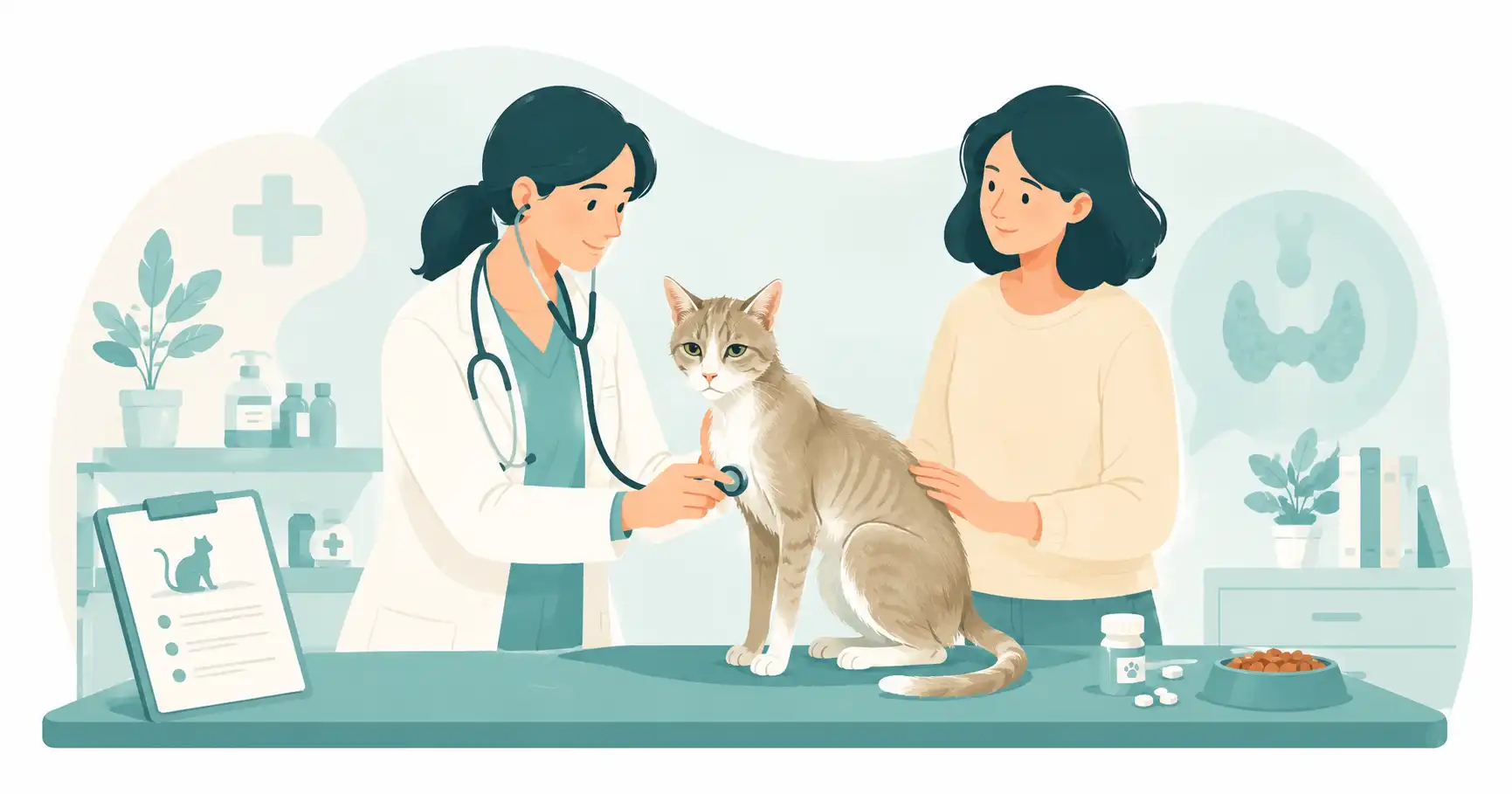
Physical Examination
A thorough physical examination provides significant initial information:
- Palpation of the thyroid glands — an enlarged thyroid lobe is palpable in approximately 80 to 90% of hyperthyroid cats as a mobile mass in the ventral neck. This is often the first clinical finding that prompts thyroid testing
- Heart rate — typically elevated, often above 200 beats per minute
- Heart murmur or gallop rhythm — secondary to cardiac changes
- Body condition and muscle condition scoring — weight loss and muscle wasting assessment
- Blood pressure measurement — hypertension assessment
Total Thyroxine — T4 Measurement
The primary diagnostic test. Total serum thyroxine (total T4) is measured in a blood sample. An elevated T4 above the normal reference range confirms hyperthyroidism in a cat with consistent clinical signs.
In the majority of affected cats, T4 is clearly elevated and the diagnosis is straightforward. A small percentage of cats — estimated at 2 to 10% — have early or mild hyperthyroidism with T4 values within the upper portion of the normal range. This is called occult hyperthyroidism.
Free T4 by Equilibrium Dialysis
A more sensitive measurement of circulating thyroid hormone — less subject to the suppressing effects of concurrent illness that can falsely lower total T4 into the normal range. Used when total T4 is in the upper normal range but hyperthyroidism is clinically suspected.
T3 Suppression Test
A dynamic test used when T4 values are equivocal — the cat is given oral T3 (liothyronine) for two days and the suppressive effect on T4 production is measured. In normal cats, exogenous T3 suppresses T4. In hyperthyroid cats, the autonomous thyroid tissue does not respond to suppression.
Technetium Scintigraphy
A nuclear medicine imaging technique that maps thyroid tissue activity. Used to identify ectopic thyroid tissue — thyroid tissue in abnormal locations that may not be palpable — and to determine whether one or both thyroid lobes are affected, which influences treatment choice. Available at specialist referral centres.
Complete Assessment Before Treatment
Before initiating treatment, a complete baseline assessment is recommended:
- Complete blood count and biochemistry panel — including kidney values, liver enzymes, and electrolytes
- Urinalysis and urine specific gravity — baseline kidney function assessment
- Blood pressure measurement
- Total T4
- Cardiac assessment — heart rate, auscultation for murmurs, chest X-ray and echocardiogram if cardiac disease is suspected
Treating Hyperthyroidism
Four treatment options are available. The choice depends on the cat’s overall health, the owner’s circumstances, the availability of specific treatments, and individual preference. All four options are effective — the best choice varies between individual cats.
Medical Management — Methimazole
How It Works
Methimazole (sold as Felimazole or compounded formulations) blocks the synthesis of thyroid hormone by the thyroid gland. It does not destroy thyroid tissue — it suppresses hormone production. This makes it reversible — if kidney function declines after starting treatment, the medication can be discontinued.
Administration
Methimazole is available in tablet form — given orally twice daily in most cats — and as a transdermal gel applied to the inner surface of the ear flap once or twice daily. The transdermal formulation is useful for cats that are difficult to tablet, though it is somewhat less bioavailable than the oral form.
Monitoring
Response to methimazole is monitored by rechecking T4 levels 2 to 3 weeks after starting treatment and dose adjusting as needed. Once stable, monitoring every 3 to 6 months is typical.
Side Effects
Side effects occur in approximately 15 to 20% of cats:
- Facial pruritus — itching of the face and neck. Usually mild and often resolves within the first two weeks
- Vomiting and inappetence — gastrointestinal side effects, most common in the first few weeks
- Haematological changes — neutropenia, thrombocytopenia. Requires blood monitoring particularly in the first 3 months
- Hepatotoxicity — elevated liver enzymes, requires monitoring
- Rarely — severe immune-mediated reactions requiring discontinuation
Advantages and Disadvantages
Advantages — reversible, allows kidney function assessment before committing to permanent treatment, immediate effect, relatively low cost.
Disadvantages — requires lifelong twice-daily medication, regular monitoring, potential side effects, some cats are difficult to medicate reliably.
Radioactive Iodine — I-131
How It Works
Radioactive iodine (I-131) is administered as a single injection or oral capsule. The thyroid gland — which has a unique affinity for iodine — selectively absorbs the radioactive iodine. The radiation destroys the overactive thyroid tissue while sparing the adjacent normal tissue, parathyroid glands, and surrounding structures.
The Gold Standard Treatment
Radioactive iodine is considered the gold standard treatment for feline hyperthyroidism:
- A single treatment cures hyperthyroidism in approximately 95% of cats
- No anaesthesia required — the cat simply receives an injection or capsule
- No daily medication required after treatment
- No surgical risk
- Selective — only destroys overactive thyroid tissue, preserving normal function where present
- Treats ectopic thyroid tissue that surgery cannot reach
Practical Considerations
The significant limitation of radioactive iodine is the requirement for hospitalisation at a specialist facility licensed to handle radioactive materials — typically for 1 to 2 weeks until the radiation level has fallen to safe levels. This extended hospitalisation can be stressful for cats and is a concern for owners.
Radioactive iodine is available at specialist referral centres. Walker Lake Veterinary Centre can provide the complete pre-treatment assessment and referral.
Hypothyroidism After Treatment
Approximately 2 to 5% of cats develop hypothyroidism — insufficient thyroid hormone — after radioactive iodine treatment. This is managed with thyroid hormone supplementation. Cats with hypothyroidism after I-131 actually have a better long-term prognosis — their CKD progresses more slowly than cats with normal or elevated thyroid function after treatment.
Surgical Thyroidectomy
How It Works
Surgical removal of the affected thyroid lobe or lobes under general anaesthesia. Unilateral thyroidectomy removes one lobe — appropriate when only one lobe is enlarged. Bilateral thyroidectomy removes both lobes — required when both are affected.
Advantages and Disadvantages
Advantages — potentially curative with a single procedure, no ongoing radiation precautions, can be performed at most veterinary hospitals.
Disadvantages — requires general anaesthesia which carries higher risk in older cats with cardiac disease, risk of damage to adjacent parathyroid glands causing hypocalcaemia, risk of recurrence if ectopic thyroid tissue is present.
Parathyroid Preservation
The parathyroid glands — four tiny glands embedded in or adjacent to the thyroid lobes — regulate calcium levels. Damage to these glands during surgery causes hypocalcaemia — low blood calcium — which can cause life-threatening muscle spasms and seizures. Careful surgical technique with preservation of parathyroid gland blood supply is essential.
Prescription Iodine-Restricted Diet — Hills y/d
How It Works
Thyroid hormone synthesis requires iodine. A diet severely restricted in iodine reduces the substrate available for hormone production, normalising thyroid hormone levels over 4 to 8 weeks.
Advantages and Disadvantages
Advantages — no medication, no surgery, no anaesthesia, no radiation.
Disadvantages — requires strict dietary exclusivity — the cat must eat absolutely nothing other than the Hills y/d diet. A single treat, access to another pet’s food, or any outdoor hunting completely undermines the treatment. This makes the diet impractical for cats with outdoor access or in multi-cat households where dietary exclusivity cannot be guaranteed.
Monitoring After Treatment
Regardless of treatment modality, ongoing monitoring is essential:
- T4 rechecked 4 to 6 weeks after initiating treatment — to confirm normalisation
- Kidney values reassessed after T4 normalisation — to identify unmasked CKD
- Blood pressure monitoring — hypertension may require specific treatment
- Cardiac reassessment — hypertrophic changes often partially reverse with successful treatment
- Long-term T4 monitoring every 6 months — to detect recurrence or hypothyroidism
Managing Concurrent Kidney Disease
The relationship between hyperthyroidism and CKD is complex and clinically important. The recommended approach is:
Start with reversible medical management — methimazole — for 4 to 6 weeks. During this trial, kidney values are monitored. If kidney function remains stable as T4 normalises, proceed to the preferred permanent treatment. If kidney function declines significantly with T4 normalisation, the dose is adjusted to maintain T4 in the high-normal range — accepting mild hyperthyroidism to protect kidney function — or the implications of different treatment approaches are discussed
If your cat is over 10 years old and has not had recent bloodwork including thyroid function, book a senior wellness check at Walker Lake Veterinary Centre. Call (587) 786-6771 or book online. Located at 5109 22 Avenue SW, Southwest Edmonton.
Book an Appointment at Walker Lake Veterinary Centre
Walker Lake Veterinary Centre provides thyroid function testing, complete pre-treatment assessment, medical management, and referral coordination for hyperthyroid cats across Walker Lake, Summerside, Ellerslie, Heritage Valley, and Southwest Edmonton.
Call us at (587) 786-6771 or book online. We are located at 5109 22 Avenue SW, Edmonton.
Clinic hours:
- Monday, Tuesday & Thursday: 9:00 AM – 7:00 PM
- Wednesday & Friday: 9:00 AM – 6:00 PM
- Saturday: 9:00 AM – 3:00 PM
- Sunday: Closed
Frequently Asked Questions
At what age should my cat be screened for hyperthyroidism?
Annual thyroid testing is recommended from age 10 onwards as part of routine senior wellness care. For cats showing signs consistent with hyperthyroidism — weight loss, increased appetite, restlessness, increased vocalisation — testing should not be delayed regardless of age.
Can hyperthyroidism be managed long-term with medication alone?
Yes. Many cats are successfully managed with methimazole for years. The requirement for twice-daily medication and regular monitoring is the primary practical challenge. For owners who are unable to medicate reliably or whose cats do not tolerate the medication, radioactive iodine or surgery provides a permanent solution.
Will treating hyperthyroidism make my cat’s kidney disease worse?
Treating hyperthyroidism can unmask pre-existing CKD that was hidden by the artificially elevated kidney blood flow caused by excess thyroid hormone. This is not a worsening caused by the treatment — it is the revelation of disease that was present but concealed. This is why a monitored trial of medical management before permanent treatment is recommended — it allows the impact on kidney function to be assessed.
My hyperthyroid cat has heart disease — can it still be treated?
Yes. Most cats with hyperthyroidism-associated heart disease are treated for both conditions simultaneously — the hyperthyroidism is controlled with methimazole while the cardiac disease is managed with appropriate medication. Cardiac changes often partially or fully reverse as thyroid hormone levels normalise. Cats with significant heart disease require more careful anaesthetic management if surgery is considered.
How quickly will my cat improve after starting treatment?
Most cats show meaningful improvement within 2 to 4 weeks of starting methimazole — appetite normalises, weight stabilises, and restlessness reduces. Full resolution of signs and normalisation of T4 typically occurs within 4 to 8 weeks of initiating appropriate treatment. Cardiac changes take longer to reverse — typically 3 to 6 months of well-controlled thyroid function.