Heatstroke is a life-threatening emergency that can develop in dogs far more quickly than most owners realise. Unlike humans, dogs cannot sweat through their skin — they regulate body temperature almost entirely through panting, which becomes rapidly ineffective in high heat or humidity. Once a dog’s core body temperature rises above a critical threshold, organ damage begins within minutes.
Edmonton summers bring genuinely dangerous heat. Knowing how to recognise heatstroke and what to do in the critical first minutes can save your dog’s life.
⚠️ If your dog is showing signs of heatstroke — extreme panting, collapsing, vomiting, or loss of consciousness — begin cooling immediately and go to Walker Lake Veterinary Centre at (587) 786-6771 without delay.
How Dogs Regulate Body Temperature
Understanding why dogs are so vulnerable to heatstroke requires understanding how they cool themselves.
Humans cool down primarily by sweating — moisture evaporates from the skin across the entire body surface, drawing heat away efficiently. Dogs have very limited sweat glands — found only on their paw pads — which contribute almost nothing to thermoregulation.
Instead, dogs pant. Rapid breathing moves air over the moist surfaces of the tongue, mouth, and upper respiratory tract, evaporating moisture and transferring heat out of the body. This mechanism works reasonably well in mild heat and low humidity, but becomes increasingly ineffective as the ambient temperature and humidity rise.
In hot, humid conditions, panting cannot remove heat fast enough. The dog’s core temperature rises, panting intensifies, the dog becomes exhausted, and the situation escalates rapidly toward heatstroke.
A dog’s normal body temperature is between 38°C and 39.2°C. Heatstroke is generally defined as a core temperature above 41°C. At 41°C, cellular damage begins. Above 43°C, widespread organ failure and death can occur within minutes.
Warning Signs of Heatstroke in Dogs
Heatstroke progresses through stages. Recognising the early signs gives you the best chance of intervening before the situation becomes critical.
Early Warning Signs
- Excessive, frantic panting that does not slow down with rest
- Thick, ropy, or foamy saliva
- Bright red gums and tongue
- Restlessness and inability to settle
- Seeking shade or cool surfaces frantically
- Slowing down or reluctance to continue exercise
Moderate Heatstroke Signs
- Vomiting and diarrhoea — sometimes containing blood
- Weakness and stumbling
- Glazed or unfocused eyes
- Muscle tremors
- Pale or blue-tinged gums — indicates cardiovascular compromise
- Rapid heart rate
- Drooling excessively
Severe Heatstroke Signs — Immediate Emergency
- Collapse or inability to stand
- Loss of consciousness
- Seizures
- Very slow, laboured breathing
- Complete unresponsiveness
⚠️ A dog that has collapsed or lost consciousness due to heat requires immediate veterinary care. Begin cooling at once and leave for the clinic immediately — do not wait to see if they improve with cooling alone.
Which Dogs Are Most at Risk?
While any dog can develop heatstroke in the right conditions, certain factors significantly increase vulnerability.
Brachycephalic Breeds
Flat-faced dogs — Bulldogs, French Bulldogs, Pugs, Boxers, Boston Terriers, Shih Tzus, and Cavalier King Charles Spaniels — are at dramatically higher risk of heatstroke than other breeds. Their shortened airways make panting less efficient at every temperature, meaning they overheat faster and have less physiological reserve to cope with heat stress.
These breeds can develop heatstroke in conditions that other dogs tolerate comfortably. During summer months, outdoor exercise for brachycephalic breeds should be limited to early morning and evening only, and even then kept brief.
Other High-Risk Categories
- Overweight and obese dogs — excess body fat acts as insulation and impairs heat dissipation
- Senior dogs — reduced cardiovascular efficiency and impaired thermoregulation
- Puppies — immature thermoregulation systems
- Dogs with heart or respiratory disease
- Double-coated and heavy-coated breeds — Huskies, Malamutes, Saint Bernards
- Dogs unaccustomed to heat — particularly those that spend most of their time indoors
- Dogs left in parked vehicles — even briefly, even with windows cracked
The Parked Car Risk
This deserves specific emphasis because it is the most preventable cause of heatstroke in dogs.
On a 24°C day — a mild summer day in Edmonton — the interior of a parked car reaches 38°C within 10 minutes and 49°C within 30 minutes. Cracking windows makes no meaningful difference to these figures. A dog left in a parked car can develop heatstroke and die in under 15 minutes on a warm day.
There is no errand short enough to justify leaving a dog in a parked car in warm weather. If you cannot take the dog with you, leave them at home.
First Aid for Heatstroke — What to Do Right Now
If you believe your dog is suffering from heatstroke, act immediately. The goal of first aid is to begin lowering body temperature while moving toward veterinary care — not to treat heatstroke yourself.
Step 1 — Move to a Cool Environment
Get the dog out of the heat immediately. Move them to a shaded area, an air-conditioned car, or indoors. Any reduction in ambient temperature helps.
Step 2 — Begin Active Cooling
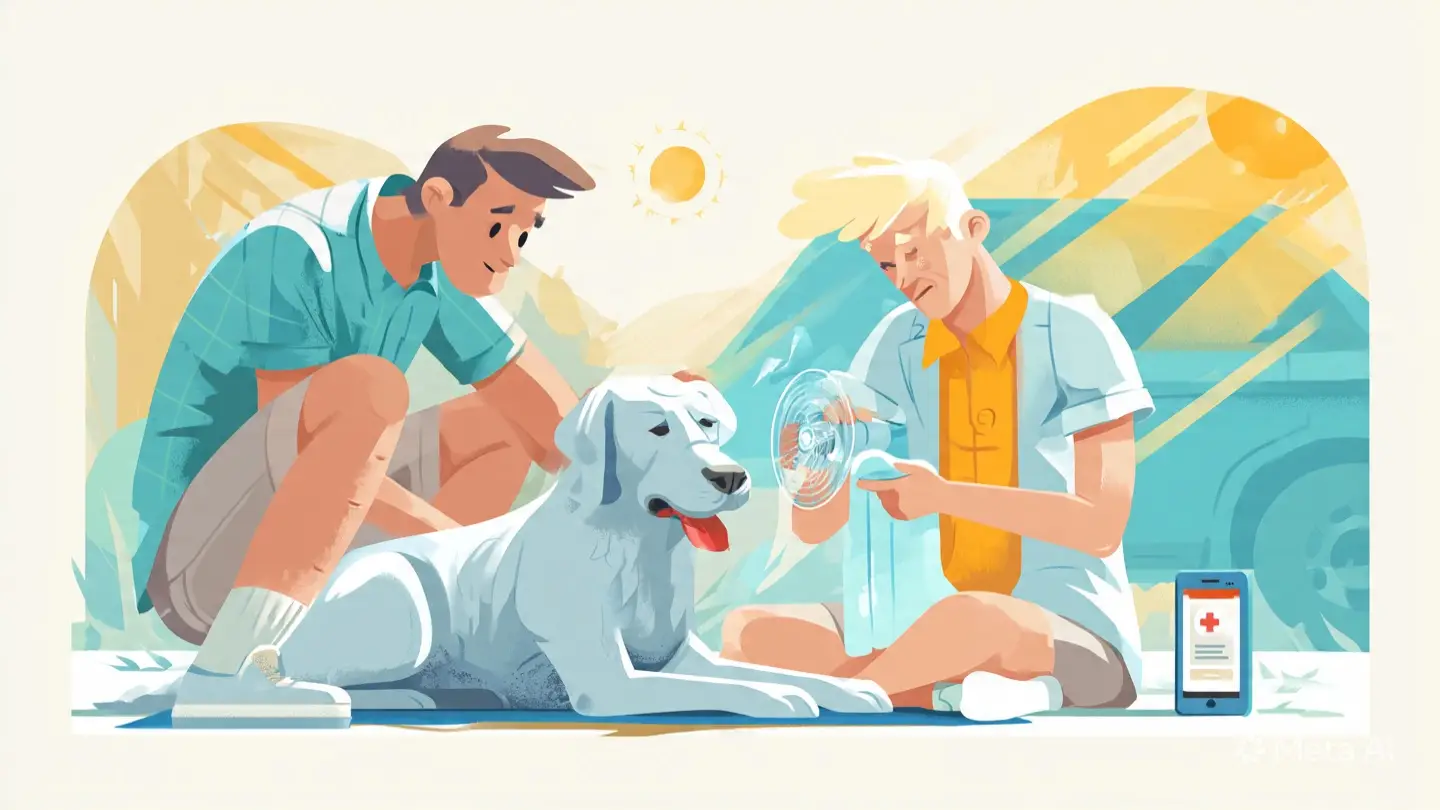
This is the most critical step. Use cool — not cold or icy — water.
- Wet the dog’s coat thoroughly with cool water — a garden hose, bucket, or tap are all suitable
- Focus on the neck, armpits, groin, and paw pads — areas where large blood vessels run close to the skin surface
- Fan the dog actively while wet — evaporation is the primary cooling mechanism
- Place wet towels over the neck and groin if water is not immediately available
- If available, place the dog on a cool surface — tiles, concrete in shade
⚠️ Do not use ice or ice-cold water. This causes peripheral blood vessels to constrict, trapping heat in the core and paradoxically making heatstroke worse. Cool tap water is correct — cold water is not.
Step 3 — Offer Small Amounts of Water
If your dog is conscious and able to swallow, offer small amounts of cool water to drink. Do not force water into the mouth of an unconscious dog — this risks aspiration into the lungs.
Step 4 — Leave for the Veterinary Clinic Immediately
Do not wait until your dog appears fully recovered before going to the vet. Even a dog that seems to be improving after cooling needs urgent veterinary assessment. Heatstroke causes internal organ damage — particularly to the kidneys, liver, brain, and blood clotting system — that is not visible from the outside and can worsen significantly over the hours following the initial event.
Continue cooling during transport by keeping windows open, air conditioning on, and wet towels in place.
Begin cooling your dog immediately and call Walker Lake Veterinary Centre at (587) 786-6771 while on your way. We are located at 5109 22 Avenue SW, Southwest Edmonton.
How Is Heatstroke Treated at the Clinic?
Veterinary treatment for heatstroke focuses on completing the cooling process safely, supporting affected organs, and monitoring for complications.
Controlled Cooling
The veterinary team will continue cooling the dog using controlled methods — cool IV fluids, cool water baths, and fans — while monitoring core body temperature continuously. Cooling is stopped once the temperature reaches approximately 39.5°C to avoid overshooting to hypothermia.
Intravenous Fluids
IV fluid therapy addresses dehydration, supports kidney function, helps maintain blood pressure, and assists organ perfusion. Most heatstroke patients require aggressive IV fluid support for at least 24 hours.
Organ Function Monitoring
Bloodwork assesses kidney values, liver enzymes, blood clotting function, blood sugar, and electrolytes. These values are repeated over 24 to 48 hours to detect organ damage that may not be apparent initially.
Treating Complications
Heatstroke can trigger a cascade of complications including disseminated intravascular coagulation (DIC — a life-threatening clotting disorder), acute kidney failure, brain swelling, and gastrointestinal bleeding. Each complication requires specific treatment and monitoring.
Prognosis
Dogs with mild to moderate heatstroke that receive prompt veterinary care have a good prognosis. Dogs with severe heatstroke — particularly those that were unconscious or seizing on presentation — have a more guarded prognosis. Survival rates decrease significantly when core temperature exceeded 43°C or when treatment was substantially delayed.
Preventing Heatstroke in Edmonton Summers
Prevention is far preferable to treatment. During warm months in Edmonton, the following measures protect your dog effectively.
Exercise Timing
Walk and exercise dogs in the early morning before 8am or in the evening after 8pm during hot weather. The hottest part of the day in Edmonton is typically between 12pm and 4pm — avoid outdoor exercise during this window when temperatures exceed 22°C.
Water Access
Ensure your dog has constant access to fresh, cool water at home and during any outdoor activity. Carry water and a collapsible bowl on all walks and hikes during summer.
Shade and Ventilation
Never leave a dog in direct sunlight without shade. Ensure outdoor spaces have shaded areas available at all times. Never leave a dog in a parked vehicle.
Coat Management
- Keep double-coated breeds well-groomed — a well-maintained coat actually provides some insulation against heat
- Discuss appropriate summer grooming with your veterinarian or groomer — shaving double-coated breeds is generally not recommended
- Trim — but do not shave — single-coated breeds if appropriate
Recognise Your Dog’s Individual Limits
Know your dog’s breed, age, weight, and health status and adjust their activity accordingly. A young, fit Labrador and an elderly overweight Pug have very different heat tolerances. Do not assume your dog will tell you when they have had enough — many dogs will continue running and playing until they collapse.
Book an Appointment at Walker Lake Veterinary Centre
Walker Lake Veterinary Centre provides urgent and emergency veterinary care for dogs and cats across Walker Lake, Summerside, Ellerslie, Heritage Valley, and Southwest Edmonton.
Call us at (587) 786-6771 or book online. We are located at 5109 22 Avenue SW, Edmonton.
Clinic hours:
- Monday, Tuesday & Thursday: 9:00 AM – 7:00 PM
- Wednesday & Friday: 9:00 AM – 6:00 PM
- Saturday: 9:00 AM – 3:00 PM
- Sunday: Closed
Frequently Asked Questions
How hot is too hot to walk a dog in Edmonton?
As a general guideline, when the air temperature exceeds 25°C — particularly in combination with humidity — exercise should be limited to brief toilet breaks for most dogs. For brachycephalic breeds, senior dogs, and overweight dogs, the threshold is lower — around 20°C. The five-second rule applies to pavement: place the back of your hand on the pavement for five seconds — if it is too hot to hold, it is too hot for your dog’s paws.
Can a dog recover fully from heatstroke?
Dogs with mild to moderate heatstroke that are treated promptly often recover fully. However, severe heatstroke can cause permanent organ damage — particularly to the kidneys and brain — that affects long-term health. Some dogs that survive severe heatstroke have ongoing health challenges as a result.
How long does heatstroke recovery take in dogs?
Recovery varies depending on severity. Mild cases may recover within 24 to 48 hours with appropriate treatment. Severe cases may require several days of hospitalisation and weeks of monitoring at home. Your veterinarian will advise on follow-up bloodwork to monitor organ recovery.
Is heatstroke more common in Edmonton than other Canadian cities?
Edmonton experiences genuine summer heat with temperatures regularly reaching 28–34°C during July and August, and occasional highs above 35°C. Combined with extended daylight hours encouraging outdoor activity, this creates real heatstroke risk. Alberta’s relatively low humidity compared to eastern Canada can create a false sense of safety — dogs can develop heatstroke even in dry heat conditions.
Can indoor dogs get heatstroke?
Yes. A dog left in a home without air conditioning during a hot Edmonton day can develop heatstroke. Ensure indoor temperatures are maintained at a safe level during heat waves, or provide cooling options such as fans, cooling mats, and access to cool water.